Autonomous Mobile Robots (AMRs)
Move Materials
Faster and Safer
Reduce forklift traffic, improve throughput and automate material movement with autonomous mobile robot solutions for warehouse and manufacturing environments.

Forklift
Congestion
Forklift traffic is creating congestion or safety concerns

Non-Value-Added Movement
Operators spend significant time moving materials instead of adding value

Production Flow Disruptions
Production flow is interrupted by manual transport or waiting

Throughput
Constraints
You need to increase throughput without adding labor or floor space
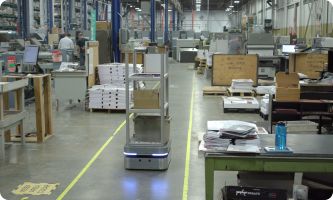
Improved Efficiency and Throughput
Autonomous mobile robots are used in warehouse and manufacturing environments to move materials continuously without manual intervention. They operate 24/7 without fatigue, improving throughput and reducing delays.
Common applications include:
Material transport between workstations, line feeding and workstation support and warehouse movement and replenishment.
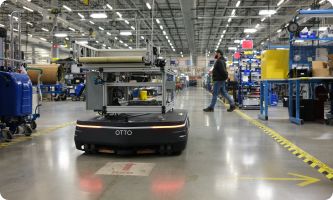
Enhanced Safety and Ergonomics
Autonomous mobile robots improve safety by reducing manual handling, repetitive movement and forklift interaction in warehouse and manufacturing environments.
Common applications include:
Reducing forklift traffic in shared spaces, automating pallet movement and eliminating manual material handling.
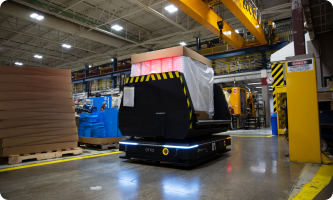
Cost Reduction and Scalability
AMRs deliver long-term savings through reduced labor costs and fewer workplace injuries while scaling easily as operations grow.
Common applications include:
Scaling without adding labor, automating repetitive transport tasks and supporting flexible production layouts.
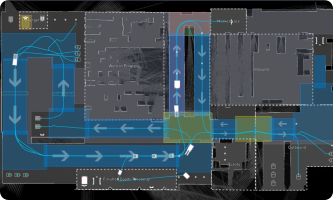
Real-Time Data and Operational Visibility
AMRs collect valuable data during operation, enabling better decision-making and continuous optimization.
Common applications include:
Tracking material movement, identifying bottlenecks and integrating with warehouse and production systems.
 Advanced Sensor Systems
AMRs use LiDAR, 3D cameras and ultrasonic sensors for precise movement and obstacle avoidance.
Enabled applications include:
Navigating dynamic environments and operating safely in shared spaces.
 Intelligent Path Planning
AMRs dynamically adjust routes based on real-time conditions to maintain optimal performance.
Enabled applications include:
Avoiding congestion and optimizing delivery routes.
 Modular and Scalable Design
Modular designs allow for easy maintenance and customization across different environments.
Enabled applications include:
Supporting different payload sizes and adapting to evolving workflows.
 Connectivity and Data Integration
AMRs integrate with IoT platforms and warehouse systems for real-time data exchange.
Enabled applications include:
System integration, tracking and performance optimization.

Start Your AMR Journey Today
Whether you're exploring automation for the first time or looking to scale your operation,
Van Meter can help you evaluate, design and implement the right AMR solution.