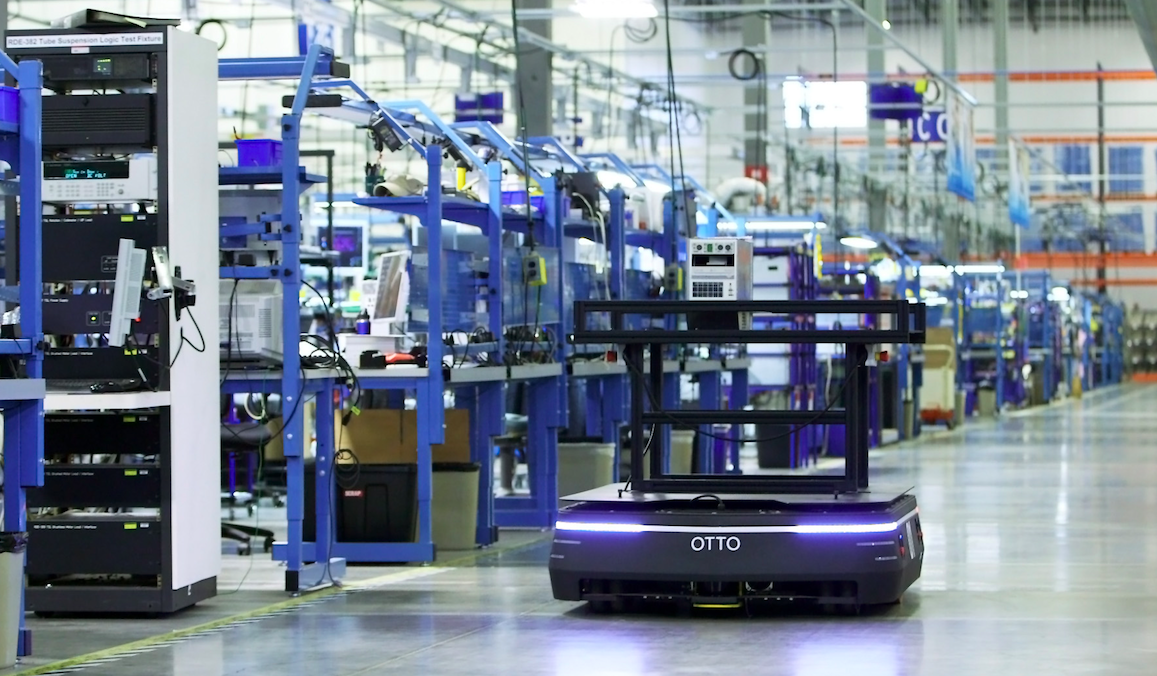
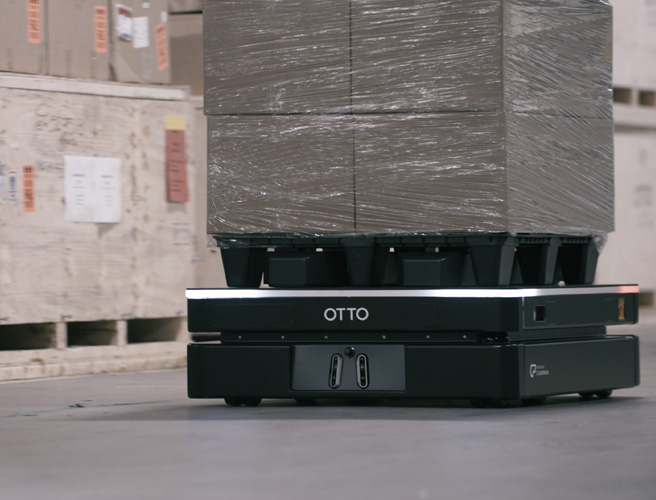
An autonomous mobile robot (AMR) moves materials across a manufacturing floor, helping improve production flow and efficiency
Manual material handling is putting a strain on your workforce, throughput and floor space. If you’re comparing AGV vs AMR, the right solution depends on how your operation handles change and material flow.
More manufacturers are using Autonomous Mobile Robots (AMRs) and Automated Guided Vehicles (AGVs) because they handle repetitive, low-value transport tasks to reduce the load on workers. They also improve efficiency, safety and consistency across the facility.
The question isn’t whether to automate. It’s whether an AGV or AMR is the better fit for your operation.
AMRs and AGVs improve material handling, throughput and safety, but the most effective solution usually depends on the application. Compare AGV vs AMR to see which one will work best for you.
AGV vs AMR at a Glance: Key Differences
Not sure which is right for your operation? Use this quick comparison to see how AGVs and AMRs differ and which one is more likely to fit your workflow.
Factor
AMR
AGV
Intelligence
On-board intelligence that adapts in real time
Pre-programmed with fixed behavior
Navigation
No fixed infrastructure required
Requires tape, wires, beacons or other infrastructure
Flexibility
Can reroute around obstacles and adjust to change
Follows fixed paths in controlled environments
Scalability
Easier to expand without layout changes
Often requires planning, infrastructure updates and retraining
Deployment
Can be redeployed across workflows and facilities
Best for repetitive applications that stay the same over time
Best Fit
Dynamic environments with changing workflows
Stable environments with repetitive, predictable routes
Quick takeaway: In most modern manufacturing and warehouse environments, AMRs offer greater flexibility and scalability, while AGVs are better suited for simple, repetitive workflows.
Think of it this way: AMRs operate like trucks. AGVs operate like trains.
AGVs and AMRs bring materials to and from workspaces, but the method in which they navigate is very different. Think of AMRs like trucks and AGVs like trains. One can reroute and adapt. The other stays locked to a track.
AGVs follow a fixed path using physical infrastructure like lasers, beacons, barcodes or magnetic tape to guide them. It makes their movement extremely predictable and repeatable, but it means multiple AGVs are needed for varying applications.
Because AMRs navigate without fixed infrastructure, a single unit can be deployed across various applications and tasks. They can detect, avoid and dynamically move around obstacles in real time to reduce downtime and limit the need for human intervention.
Unlike AGVs, AMRs can also navigate through alternate routes like aisleways, personnel zones and narrow corridors if their usual path is blocked. This makes them a flexible, scalable solution that is easy to implement.
AGV VS AMR: SCALABILITY
AGVs work best in simple, stable, high-throughput applications, but scaling an AGV solution is more complex. Adding another AGV is possible if the facility layout meets the AGV’s infrastructure requirements, but doing so takes a larger investment in facility planning, infrastructure updates, maintenance and operator training.
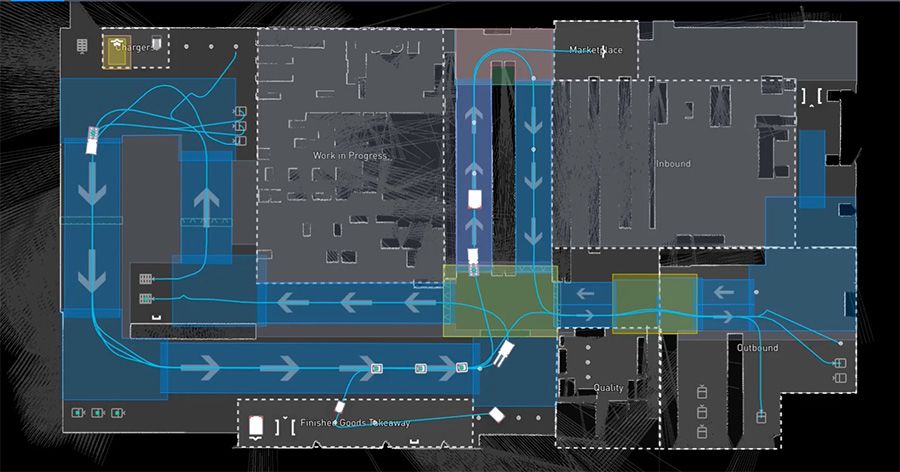
AMRs are simple for end users to configure and deploy. They can be made operational in less than a day because they operate based on a centrally controlled map shared among the fleet.
Adding AMRs does not require any infrastructure renovations, facility planning or additional training. It’s simple enough for end users to implement new units, so AMR customers do not have to outsource work to third-party vendors for changes and implementation.
AGV VS AMR: DEPLOYMENT FLEXIBILITY
AGVs work well for repetitive applications that do not change over time, but when plant layouts and processes evolve, moving an AGV is equivalent to installing an AGV system for the first time. It takes significant cost and time to alter the infrastructure that guides them and the programming to integrate them.
AMRs can be redeployed from one plant or work zone to another without rearranging infrastructure. Autonomous mobile robots by OTTO are centrally controlled with OTTO’s Fleet Manager software. It makes re-deploying AMRs as simple as making adjustments in the software.
That means multiple facilities can share AMR units to alleviate seasonal demands. When AMRs become a shared resource, fewer units are required for purchase.
Why Choose OTTO?
Labor shortages and rising productivity demands are reshaping manufacturing. OTTO AMRs help overcome these challenges by automating material handling, improving throughput and maintaining safety.
The simplicity of AGVs can be good or bad depending on your perspective. On one hand, AGVs don’t require intelligence due to the physical infrastructure that guides the AGV. On the other hand, the AGV is not collecting data to give plant operators performance insights. Plus, AGVs are more difficult to integrate with smart manufacturing solutions.
AMRs have onboard intelligence that can adapt to changing environments. OTTO AMRs have built-in machine learning that collects data to learn which routes are fastest and take optimal paths to recurring obstructions. This updated map data can be distributed to the fleet’s shared map. Historical data within the AMR can be captured and replayed to optimize system performance.
Integration with other solutions like ERPs, WMSs and SCADA systems through the Fleet Manager can help solve more complex deployment needs.
The Fleet Manager optimizes deployment of missions and health of the AMRs. It manages and optimizes which AMRs are available, closest to where the work is to be done, and adequately charged. They use opportunistic charging, meaning they optimize charging times and levels to ensure availability and prevent downtime.
AMR fleet management software uses real-time data and mapping to optimize routes, coordinate movement and improve overall system efficiency.
AGV VS AMR: EASE OF USE
For a solution designed to perform simple tasks, AGVs can be costly and complex to implement and maintain. AGVs require training by certified personnel, and any changes to the system require infrastructure updates and additional staff training.
Implementing AMRs starts with a one-time facility mapping process using one robot. Once it creates the map, users can define end points in the Fleet Manager software through a simple point-and-click interface. From there, plant personnel can create workflows and adjust zones and traffic rules as needed. This makes it easier to adapt to changes in production lines and distribution layouts.
AGV VS AMR: WHICH SHOULD YOU CHOOSE?
The final decision in an AGV vs AMR comparison comes down to factors like environment stability, task complexity and how much flexibility your operation needs.
In the simplest terms, AGVs work great for settings with predictable patterns and high repetition, while AMRs offer flexibility for tasks that require navigation around obstacles or dynamic routing.
OVERCOME MATERIAL HANDLING CHALLENGES
Material handling doesn’t have to be the bottleneck in your operation. If you’re seeing labor gaps, safety concerns or inefficiencies in your material flow, it may be time to take a closer look at a solution. See how autonomous mobile robots from OTTO by Rockwell Automation are helping manufacturers redistribute work and increase throughput without compromising on safety.